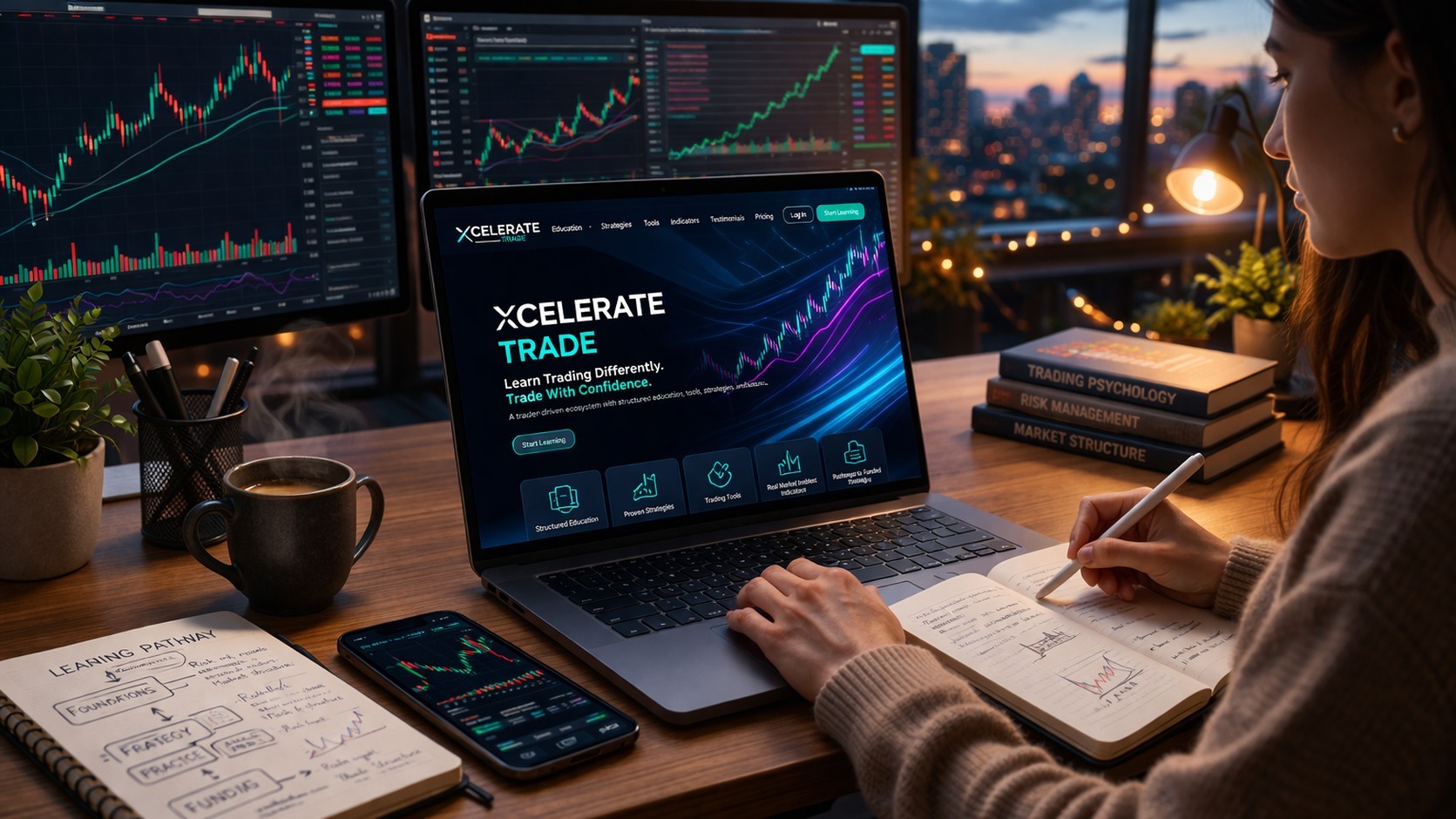
The first currency chart I studied looked almost harmless. A few green and red candles moved across a pale screen while my coffee sat untouched beside the keyboard. Nothing about the scene suggested urgency, yet every small movement represented money changing hands somewhere in the world.
That contrast still interests me. Currency trading takes place on an ordinary screen, sometimes in an ordinary room, but the market behind it connects banks, companies, governments, investment funds, importers, exporters, and individual traders. It feels close enough to touch, although the forces moving it are often enormous.
For a beginner, that scale can be both attractive and misleading. Opening a chart is easy. Understanding what the chart represents, why prices move, and how quickly leverage can damage an account takes more patience.
This is where a structured learning platform can help. Xcelerate Trade brings education, practice, market observation, and strategy development into the same environment, which can make the early learning process less scattered. Instead of jumping from one random video to another, a beginner can follow a clearer route.
I would still begin with one sober idea. No platform can make a financial market predictable, and no course can remove risk. What a good learning environment can do is help a person understand that risk before real money is involved.
What Foreign Exchange Trading Actually Means
Foreign exchange trading is the process of buying one currency while selling another. The two currencies appear together as a pair because their values are always compared. A currency does not rise or fall in complete isolation.
Consider EUR/USD, one of the most widely followed currency pairs. The euro is the base currency, while the US dollar is the quote currency. If the pair is priced at 1.0850, one euro is worth 1.0850 US dollars.
A trader who buys the pair expects the euro to strengthen against the dollar. Someone who sells it expects the euro to weaken. The position gains or loses value as that relationship changes.
This sounds straightforward, and at the mechanical level it is. The difficulty appears when real money, economic news, leverage, and emotion enter the picture. A clear definition is only the first floor of the building.
The global foreign exchange market is also much larger than the retail trading world seen on social media. According to the Bank for International Settlements, average daily turnover reached roughly 9.6 trillion US dollars in April 2025. Most of that activity came from financial institutions and large professional participants rather than private individuals.
I mention that figure because it restores a sense of proportion. A beginner is not entering a private contest between people staring at identical charts. The market also serves international trade, investment, hedging, banking, and government activity.
Why Currencies Are Traded
Companies often need foreign currencies to pay suppliers, employees, or taxes in another country. A Romanian business importing equipment from the United States may need dollars, while a German company selling products in Japan may eventually convert yen into euros. These transactions are commercial rather than speculative.
Investment funds also exchange currencies when moving capital between countries. A fund buying British shares may need pounds, while another fund may hedge the currency exposure attached to an overseas investment. Banks process many of these flows and also trade currencies for their own clients or accounts.
Central banks influence currency values through interest-rate decisions, monetary policy, and market intervention. Governments affect expectations through budgets, borrowing, taxation, and political choices. Large corporations may hedge future payments so that an exchange-rate move does not ruin an otherwise profitable contract.
Retail traders form a smaller part of this broad landscape. They generally try to benefit from short-term or medium-term changes in exchange rates, often through leveraged products offered by brokers. Their purpose differs from that of an exporter paying an invoice, even though both participate in the same market.
Understanding this difference helped me stop seeing every movement as a signal designed for traders. Sometimes a currency rises because large institutions are repositioning before a central-bank meeting. Sometimes a company is hedging a commercial exposure, and sometimes liquidity simply becomes thin.
The market is not sending anyone a personal message. It does not know where a small trader entered or where that person placed a stop. This may sound obvious, but it becomes surprisingly easy to forget after a losing position.
How Currency Pairs Are Quoted
Every currency pair has a base currency and a quote currency. The first currency is the base, and the second tells us how much is required to buy one unit of that base currency. This format allows traders to compare the relative value of two economies.
In GBP/USD, the British pound is the base currency and the US dollar is the quote currency. If the price rises, the pound has strengthened relative to the dollar. If it falls, the dollar has strengthened relative to the pound.
Beginners sometimes reverse this relationship in their heads. They read that the dollar is becoming stronger and buy a pair in which the dollar appears second. The trade then moves in the opposite direction from the idea they intended to express.
I find it useful to say the trade aloud in plain language. Buying EUR/USD means buying euros and selling dollars. Selling EUR/USD means selling euros and buying dollars.
That small habit can prevent a surprisingly common mistake. A trading platform may execute an order in less than a second, but it cannot check whether the idea behind the order was expressed correctly.
Major Pairs, Crosses, and Less-Liquid Markets
Major currency pairs usually include the US dollar and another heavily traded currency. Common examples involve the euro, British pound, Japanese yen, Swiss franc, Canadian dollar, Australian dollar, and New Zealand dollar. These markets often have deeper liquidity and narrower spreads.
Currency crosses do not include the US dollar. EUR/GBP and EUR/JPY are familiar examples. They can offer useful opportunities, although their behaviour may differ from the major pairs a beginner first encounters.
Less-liquid markets can involve currencies from smaller or emerging economies. Their spreads may be wider, and they can move sharply when political or economic conditions change. Access may also depend on the broker and the regulations in a particular country.
I would not begin by watching twenty pairs at once. That tends to create the feeling of being busy without producing much understanding. One or two liquid pairs provide enough material for months of serious observation.
Familiarity matters. After following the same pair for a while, a learner begins to notice how it behaves during different trading sessions, around major announcements, and near important price levels. That knowledge grows slowly, but it is more useful than constantly chasing whichever chart happens to be moving.
Understanding Bid, Ask, and Spread
A trading platform usually shows two prices for the same currency pair. The bid is generally the price at which a trader can sell, while the ask is the price at which the trader can buy. The distance between them is called the spread.
Suppose a pair shows a bid price of 1.0849 and an ask price of 1.0851. A buyer enters at the higher price. If the position were closed immediately, it would normally be sold at the lower price.
The trade therefore begins with a small cost. Price has to move far enough in the trader’s favour to overcome that difference. When spreads widen, the required movement becomes larger.
Spreads are often narrower in liquid markets during active hours. They can become wider during quiet periods, around major economic announcements, or when market conditions become disorderly. A strategy that looks profitable on a clean historical chart may perform differently when real transaction costs are included.
This is especially important for traders who enter and exit frequently. A small cost repeated many times is no longer small. It becomes part of the strategy, whether the trader has planned for it or not.
Pips, Lots, and Position Size
A pip is a standard unit used to describe a small change in a currency price. For many currency pairs, it refers to movement in the fourth decimal place. Yen pairs are usually quoted differently, so beginners should always check the convention used for the instrument they are trading.
A lot describes the size of a position. Standard lots, mini lots, and micro lots represent different quantities, although many brokers allow more flexible sizing. The cash value of each price movement depends on the position size.
This relationship deserves attention because two traders can take the same market direction and experience very different outcomes. One may lose a manageable amount, while the other loses a large part of the account. The chart was identical, but the position size was not.
I prefer to begin with the maximum acceptable loss. The trader decides how much money can be risked if the idea fails, then calculates a position size based on the distance to the stop. The size should adapt to the trade, not the other way around.
A beginner who chooses a position first may place the stop where the loss feels affordable. That can produce a stop with no connection to market structure. The trade may then be closed by ordinary price noise rather than by genuine invalidation of the idea.
Leverage and Margin
Leverage allows a trader to control a position that is larger than the cash committed to it. It is one of the main reasons currency trading attracts beginners. It is also one of the main reasons many retail accounts suffer severe losses.
If a trader uses leverage of 30 to 1, a relatively small amount of capital can create exposure thirty times larger. A modest market move can then produce a noticeable gain. The same move in the opposite direction can produce an equally noticeable loss.
Margin is the money required to support that leveraged position. It should not be confused with the total value of the trade. A small margin requirement does not mean the trade itself is small.
When losses reduce the available funds in an account, the broker may close positions according to its margin rules. This can happen during a fast move, sometimes at a price worse than the trader expected. Market gaps and slippage can make the result even less comfortable.
Leverage changes behaviour as much as it changes arithmetic. When a position is too large, every minor movement begins to feel important. The trader stops evaluating the market calmly and starts hoping, bargaining, or reacting.
I have seen sensible trading plans become unrecognisable once the position size was increased. The chart had not changed, but the person reading it had. That is why risk management is not a decorative chapter placed at the end of trading education.
What Makes Currency Prices Move
Currency prices move because expectations about two economies are constantly changing. Traders and institutions respond to interest rates, inflation, employment, economic growth, government policy, political events, and international capital flows. Commodity prices can also matter for countries whose economies depend heavily on natural resources.
Interest rates receive particular attention. Higher rates can make a currency more attractive because investors may seek better returns. The effect is not automatic, however, because the market may already have expected the decision.
A central bank can raise rates and still see its currency fall. This may happen if the increase was fully priced in or if policymakers suggest that no further increases are likely. The reaction depends on the difference between what happened and what participants expected to happen.
Inflation data can produce similar surprises. A high figure may support a currency if it increases expectations of tighter monetary policy. It may also weaken the currency if investors believe the economy cannot tolerate higher rates.
Political uncertainty, elections, conflicts, trade disputes, and changes in government spending can affect confidence. During periods of stress, capital may move toward currencies perceived as safer or more liquid. These patterns are not permanent, but they often shape short-term behaviour.
A beginner does not need to become an economist before opening a chart. It is still wise to know when major announcements are scheduled. Trading through an important central-bank decision without being aware of it is less a strategy than an accident.
Fundamental Analysis
Fundamental analysis studies the economic and political conditions that may influence a currency. The focus is comparative because a currency pair contains two economies. Strong data in one country may matter less if conditions in the other country are improving even faster.
A trader might compare interest-rate expectations, inflation trends, employment conditions, and central-bank language. The aim is to understand the broader pressure behind a currency pair. This can help explain why a market has been trending for weeks rather than hours.
The difficulty is that markets often react before the data arrives. Prices reflect expectations, rumours, positioning, and professional forecasts. When the official number is finally released, much of its impact may already be present in the price.
I do not think beginners should try to predict every economic announcement. A more useful first step is learning what the announcement measures and why the market cares. That knowledge provides context without turning every data release into a gambling event.
Fundamental analysis is especially helpful for avoiding trades that conflict with powerful economic themes. It does not provide perfect timing. A correct long-term idea can still suffer a painful short-term move.
Technical Analysis
Technical analysis focuses on price behaviour. Traders examine trends, ranges, support, resistance, momentum, volatility, and recurring market structures. Some use indicators, while others prefer relatively clean charts.
A chart does not reveal the future with certainty. It helps a trader organise information and define a clear point at which an idea is no longer valid. This practical function matters more than the appearance of the chart.
Support is generally an area where buying interest has appeared before. Resistance is an area where selling pressure has previously become stronger. Neither level is a wall, and both can fail.
Indicators can help measure conditions such as momentum or volatility. They do not create information from nothing. Most are mathematical transformations of price, so adding several similar indicators may only repeat the same message in different forms.
I tend to value simple technical plans because they are easier to test. If a setup requires five indicators, three exceptions, and a special interpretation for every losing trade, it becomes difficult to know whether the method has any real consistency.
Market Sentiment
Market sentiment describes the general attitude of participants toward risk and toward a particular currency. A trade can become crowded when too many participants hold similar positions. This can make the market vulnerable to a sharp reversal.
Sentiment is not always visible from price alone. Traders may study positioning data, volatility, correlations, and the behaviour of related markets. News coverage can also provide clues, although headlines often arrive after a move is already well developed.
During periods of fear, investors may reduce exposure to assets considered risky. During calmer periods, they may seek higher returns elsewhere. These shifts can affect several currency pairs at the same time.
I see sentiment as context rather than a complete trading method. It can explain why a technically attractive setup carries more risk than usual. It can also warn a trader that an apparently obvious idea may already be crowded.
Turning an Idea into a Trade Plan
A trade should begin as a hypothesis. The trader identifies a reason for expecting a particular movement, chooses an entry area, defines where the idea becomes invalid, and decides where profit may reasonably be taken. Position size connects all of these choices to the account.
For example, a trader may observe that a currency pair has broken above a well-defined range. The price then returns to test the former resistance area, which may now act as support. The trader waits for evidence that buyers are returning before entering.
The stop can be placed below the area that supports the idea. If price breaks firmly beneath that level, the original reasoning is weakened. The target might be based on the next resistance area or on a chosen relationship between potential profit and potential loss.
Nothing about this plan guarantees a winning result. It does, however, create a decision that can be reviewed later. Without a clear plan, every outcome can be explained after the fact.
A trader who writes the reasoning before entering has less room for convenient memory. The journal shows what was believed at the time, not what became obvious after the chart had already moved.
How Beginners Can Learn with Xcelerate Trade
The public structure of Xcelerate Trade separates learning, practice, strategy development, and broader trading tools. I find that distinction useful because reading about a concept is different from applying it under pressure. Beginners need both knowledge and repetition.
The educational side can help build a foundation in market mechanics, risk management, technical analysis, and trading psychology. A structured course can prevent the common habit of studying advanced strategies before understanding position size or margin. Learning in sequence may feel slower, but it usually saves time later.
Xcelerate.Trade also places emphasis on simulated practice. A demo environment allows beginners to place orders with virtual capital, become familiar with the platform, and observe how trades behave. Mistakes still teach something, but they do not immediately damage personal savings.
Historical replay can make that practice more efficient. Instead of waiting days for a setup to appear, a learner can revisit earlier market sessions and test the same rules repeatedly. This is similar to practising a difficult piece of music rather than performing an entire concert whenever one passage needs work.
A performance journal can also help expose patterns that memory prefers to hide. Traders often remember a well-planned winning trade and forget the three impulsive entries that came before it. Written records make that kind of editing more difficult.
The economic calendar adds another practical layer. It allows beginners to see when major announcements are scheduled and to understand why volatility may increase. News tools can then help connect market movement to broader economic developments.
Strategy resources and automated tools can become relevant later. I would not start there. A beginner should first understand what a tool measures, how the strategy manages risk, and what conditions might cause it to fail.
A Sensible Learning Path for the First Three Months
During the first few weeks, I would focus on language and mechanics. The learner should understand currency pairs, bid and ask prices, spreads, pips, trade size, leverage, margin, market orders, pending orders, stop losses, and profit targets. These concepts are not exciting, but they prevent expensive confusion.
The student can use Xcelerate Trade to follow structured lessons and then explain each idea in ordinary language. If margin can only be described by repeating a textbook sentence, the concept probably needs more work. Real understanding tends to survive paraphrasing.
The next stage should take place in a demo account. The goal is not to produce an impressive virtual profit. The goal is to place, modify, and close trades without accidental size, reversed direction, or forgotten stops.
I would choose one liquid currency pair and observe it during the same part of the day. This creates a manageable routine. Watching too many markets encourages random entries because something is always moving somewhere.
After the mechanics become comfortable, the learner can build one simple setup. It may involve a trend continuation, a breakout, or a reaction near support and resistance. The rules should be clear enough that another person could identify the same conditions.
Historical replay can help test that setup across different sessions. The trader records screenshots, entry reasons, stop placement, target placement, and the final result. More importantly, the trader records whether the rules were followed.
Risk management should then receive its own period of focused study. The learner can test different stop distances and adjust position size while keeping the cash risk stable. This shows how account exposure changes even when the chart setup looks identical.
During the final part of the three-month period, the learner can add economic context. Major inflation reports, employment releases, and central-bank decisions should be marked in advance. The purpose is not to predict every result but to avoid entering a volatile event by mistake.
At the end of the period, I would review the process rather than stare only at the account balance. Did the trader follow the same setup? Were transaction costs considered? Were losses accepted without moving the stop?
A profitable demo month can still be produced by reckless behaviour and good luck. A modest or slightly negative result can come from a disciplined process that needs refinement. The journal helps separate those two situations.
Why Demo Trading Matters
Demo trading is the safest place to learn platform mechanics. It allows beginners to make ordinary mistakes without turning each one into a financial problem. This includes errors in position size, order type, stop placement, and trade direction.
Simulation is also useful for testing whether a strategy has clear rules. If the learner cannot apply the same method consistently with virtual money, adding real money will not improve the situation. It will usually make the inconsistency more emotional.
At the same time, demo trading has limits. Virtual losses do not affect rent, savings, or confidence in the same way as real losses. A person may behave calmly in simulation and become impulsive after funding an account.
For that reason, the transition to live trading should be gradual. The smallest practical position size can serve as another learning stage. The objective is to observe how decision-making changes when money is genuinely at risk.
If a small loss produces anger or a strong need to recover the money immediately, the position is probably too large. The market may be offering useful information about the trader rather than about the currency pair.
Risk Management Before Profit
Risk management is often presented as a defensive subject. I see it as the part that allows a strategy to survive long enough to be evaluated. Without it, a few ordinary losses can end the learning process.
A trader should decide the maximum acceptable loss before entering a position. This amount should be small enough that the next decision can still be made calmly. The exact percentage depends on the account, the method, and the person’s financial situation.
The stop should reflect the market structure. The position size should then be adjusted so that reaching the stop produces the planned loss. This order matters because it prevents risk from being disguised by an arbitrary stop.
Daily and weekly loss limits can also protect decision quality. After several losing trades, attention often narrows and impatience grows. A planned stopping point can prevent a difficult session from becoming a damaged account.
I would also avoid using money needed for ordinary life. Trading capital should be separate from rent, food, debt payments, emergency savings, and other essential expenses. No strategy performs better because the trader urgently needs it to work.
Trading Psychology Without Empty Slogans
Trading psychology is sometimes reduced to motivational phrases. The real subject is less glamorous. It concerns how people behave when outcomes are uncertain and money is involved.
Fear can make a trader close a good position too early. Greed can keep a profitable trade open long after the original target has been reached. Frustration can produce revenge trading, while boredom can turn an average chart into an imagined opportunity.
A journal helps because emotions become easier to study when attached to specific decisions. The trader can record what happened before the entry, how the position felt while open, and whether the plan changed under pressure. Patterns often appear after several weeks.
One person may repeatedly trade too early because waiting feels uncomfortable. Another may avoid valid entries after a loss. Someone else may increase size after a winning streak because confidence has quietly become carelessness.
These habits cannot be fixed by repeating that discipline is important. They need concrete rules, smaller risk, and honest review. Sometimes the best psychological adjustment is simply reducing the position size.
Common Beginner Mistakes
Overtrading often begins as enthusiasm. A beginner opens the platform intending to practise, sees no clear setup, and gradually lowers the standard for entry. The trade is taken because the person wants activity, not because the market offers a strong reason.
Strategy hopping creates a similar problem. A method loses several times, so the trader replaces it with another method discovered online. Before enough evidence is collected, that method is abandoned as well.
This cycle produces a large collection of indicators and very little reliable data. The trader feels informed because many strategies have been studied. In reality, none has been tested consistently.
Excessive leverage causes more immediate damage. It makes ordinary price movement feel threatening and encourages emotional decisions. A trader may move the stop, close too early, or add to a losing position simply because the exposure is too large.
Trading during major news without preparation is another common mistake. Spreads can widen, execution can become less predictable, and price can move sharply in both directions. A clean plan may behave very differently in those conditions.
Copying another trader without understanding the risk is equally dangerous. A strong return does not reveal everything about leverage, drawdown, concentration, or the possibility of future losses. Past performance cannot promise a similar result.
Automated tools deserve the same caution. Automation can execute rules consistently, but it can also execute bad rules quickly. The person using the system still needs to understand its logic, limits, and risk.
Choosing a Broker Carefully
A learning platform and a broker do not necessarily perform the same role. The broker holds the trading account and executes positions, while the education platform may provide courses, practice tools, and market resources. Beginners should understand which company is responsible for each part.
Regulatory status should be checked directly with the relevant financial authority. A logo or statement on a website is not enough. The legal entity named in the client agreement matters more than the brand name displayed in large letters.
The trader should also read the fee schedule. Spreads, commissions, overnight financing, inactivity fees, currency conversion charges, and withdrawal costs can affect the final result. A low advertised spread may not represent the complete cost.
Margin rules and position-closing policies deserve careful attention. The trader should know when the broker may close a position and whether negative balance protection applies. These protections vary by country and account type.
Withdrawal procedures also matter. A beginner should understand which documents are required, how long processing normally takes, and which payment methods are supported. These details are easier to check before money is deposited.
How Much Money Should a Beginner Use?
There is no universal starting amount. The account must be large enough to support sensible position sizing, but small enough that losing it would not damage daily life. Both conditions matter.
A very small account may encourage excessive leverage because the trader wants meaningful cash returns. A large account can make early mistakes unnecessarily expensive. The right amount depends on personal finances, broker rules, trade size flexibility, and the chosen strategy.
I would start by deciding how much can genuinely be lost without affecting essential expenses. This is different from asking how much money is available. Available money may still have another important purpose.
The account should not contain borrowed money or emergency savings. It should not carry the burden of producing rent or replacing a salary. Financial pressure makes patient decision-making much harder.
If a planned loss causes panic, secrecy, or an urgent desire to win the money back, the amount is too high. That remains true even when another trader considers the same amount small.
Can Beginners Become Consistently Profitable?
A beginner can become more knowledgeable, more disciplined, and potentially profitable. There is no reliable timetable, and no educational platform can guarantee the outcome. Market conditions change, and every strategy goes through difficult periods.
Consistency requires a meaningful sample of trades. One profitable week may reflect skill, luck, or a market environment that suited the strategy. The trader needs enough data to distinguish between them.
Losses are not proof that a method is useless. They are part of any realistic trading process. The important question is whether those losses remain within the planned limits.
A good trade can lose, and a poor trade can win. That is one of the most uncomfortable lessons in trading. Judging every decision by the immediate result encourages bad habits.
Xcelerate.Trade can provide a useful framework for learning, practice, replay, and review. The platform cannot remove uncertainty or replace personal responsibility. Its value depends largely on how seriously the learner uses the tools.
Using Forex Education Without Chasing Shortcuts
A platform becomes useful when it turns curiosity into a repeatable learning routine. Courses provide structure, demo tools provide practice, and a journal provides evidence. Each part solves a different problem.
The Academy can help beginners learn concepts in an order that makes sense. Practice tools can then show whether those concepts survive contact with a moving market. Replay allows the same idea to be tested more than once.
I would resist the temptation to jump straight to advanced strategies or automation. Those features become more useful after the learner understands position size, transaction costs, and market conditions. Otherwise, complexity can hide a very basic risk problem.
The same caution applies to community features and shared strategies. Other traders can provide ideas, but they cannot know another person’s finances, emotional tolerance, or goals. A copied decision still produces a personal loss.
The healthiest use of Xcelerate Trade is as a workshop. The learner studies, practises, records, adjusts, and repeats. Progress becomes visible in the quality of decisions rather than in the number of trades placed.
Final Thoughts
The foreign exchange market looks simple because the basic action involves only buying one currency and selling another. The simplicity ends when leverage, economic expectations, costs, and human behaviour begin interacting. That is where real learning starts.
For beginners, Xcelerate Trade can bring order to a subject that often feels fragmented. Structured lessons, simulated trading, historical replay, economic tools, and journaling can support a more deliberate process. The platform works best when used slowly and honestly.
I would measure progress by quieter signs. The learner understands the trade before entering, knows the possible loss, accepts the stop, and records the result without rewriting the story. There is no drama in that routine, which may be why it works.
The chart still moves, sometimes gently and sometimes with no manners at all. The difference is that the beginner no longer feels obliged to follow every movement. The hand can remain beside the mouse, and the account can remain untouched.
Frequently Asked Questions
What is foreign exchange trading in simple terms?
Foreign exchange trading means buying one currency while selling another. The currencies are quoted as a pair, and the trader gains or loses money when their relative value changes. Retail traders usually access these price movements through a broker.
Is currency trading suitable for complete beginners?
It can be studied by complete beginners, but it should not be treated as easy income. New traders need to understand leverage, margin, position size, transaction costs, and the possibility of losing money. Demo practice is usually a more sensible starting point than immediate live trading.
How can Xcelerate Trade help a beginner learn?
Xcelerate Trade can provide a structured environment for education, simulated practice, historical replay, market observation, and performance review. This can help beginners move from theory to repeated practice. The tools are most useful when the learner follows a clear routine rather than switching constantly between methods.
Can I learn without risking real money?
Yes. Beginners can study market concepts, use a demo account, practise order placement, and test strategies with virtual capital. Historical replay can also provide repeated practice without waiting for live setups to appear.
How long does it take to learn currency trading?
The basic terminology and platform mechanics can be learned within several weeks. Developing consistent judgement usually takes much longer because the learner needs experience with different market conditions. No fixed period guarantees profitability.
How much money should a beginner start with?
A beginner should use only money that can be lost without affecting essential expenses or financial security. The amount must also allow sensible position sizing under the broker’s rules. Starting with a large account does not compensate for limited experience.
What is leverage, and why is it risky?
Leverage allows a trader to control a position larger than the amount deposited as margin. It increases the effect of both gains and losses. Excessive leverage can turn an ordinary market movement into a major account loss.
Is demo trading the same as live trading?
The mechanics can be similar, but the emotional experience is different. Virtual losses do not create the same pressure as losing real money. Demo trading is valuable for learning and testing, while live trading requires an additional adjustment to real financial risk.
Do beginners need technical indicators?
No indicator is compulsory. Some traders use indicators to measure momentum, trend, or volatility, while others prefer simpler price charts. The important point is understanding what an indicator measures rather than adding many tools without a clear purpose.
Can copy trading guarantee better results?
No. Copy trading transfers another person’s decisions into the follower’s account, but it does not remove risk. The copied trader may experience losses, change behaviour, or use a level of leverage that does not suit the follower.
Should beginners trade during major economic announcements?
Beginners should be cautious around major announcements because spreads can widen and prices can move rapidly. It is often better to observe these events before attempting to trade them. The economic calendar can help identify periods of elevated risk.
Is Xcelerate.Trade a replacement for a regulated broker?
An education or practice platform should not automatically be treated as a broker. Users need to verify which legal entity holds funds and executes trades. Broker regulation, fees, margin rules, and account protections should be checked separately.