Someone asked me this over coffee about three weeks ago and I gave a bad answer. I said “depends”, which is what you say when you have not thought about a question hard enough to defend a position on it. So I went home and thought about it properly, because the question deserves better than a shrug.
Here is where I landed. Learning to trade in 2026 is worth it for a smaller group of people than the internet implies, and it is worth considerably more to that group than the internet implies. Those two claims sound like they cancel each other out. They do not.
Let me work through why, and then I will get to where a platform like Xcelerate Trade actually sits in the picture. That part usually gets either oversold or waved away, and almost never described accurately.
The market you are walking into is not the one from the videos
Most of the trading content still circulating online was filmed between 2020 and 2022. Strange period. Stimulus money everywhere, retail enthusiasm at levels nobody had seen since the nineties, and a market that mostly went up, which taught an entire cohort that buying dips works because for roughly eighteen months buying dips did work.
Anyone who started then and quit in 2023 left with a badly distorted picture of how markets behave. I know a guy in Cluj who made around four thousand euro in his first four months and became convinced he had cracked something. He gave most of it back the following year and then blamed his broker. Not a stupid man at all, he just mistook a rising tide for a skill.
The 2026 market has a different texture to it. Rates have moved around more than almost anyone forecast, index concentration in a handful of enormous technology names is still extreme, and volatility now shows up in short violent clusters rather than in steady waves. That last detail matters more than people realise, since a lot of retail strategy quietly assumes gentle, tradeable trends.
Access got cheap, competence did not
This is where the confusion starts. Opening an account has become trivially easy. Commission on stocks is zero or near zero at most brokers, fractional shares let you own a slice of a two hundred dollar share for fifteen euro, and the whole signup takes about eleven minutes on a phone.
That cheapness is real and I think it is a good thing. It also sent a false signal. When the barrier to entry collapsed, people assumed the barrier to competence collapsed with it, and those are two separate walls. Only one of them came down.
I keep coming back to a cooking comparison. Having a kitchen, a decent knife and a supermarket downstairs does not make you a cook. It removes your excuses for not learning to be one.
The easy money got automated away
The other shift is less comfortable to talk about. Many of the simple edges that used to exist have already been eaten. Statistical arbitrage went first, then the obvious mean reversion setups, then most of the patterns you could once spot on a daily chart and trade profitably for a few years. Machines arrived earlier and moved faster.
What is left for a human is not speed. Nobody working from a laptop in a small European city is outrunning a colocated system in New Jersey, and pretending otherwise is a reliable way to lose money. What remains is judgement, the patience to wait, an honest sense of how much to risk, and the discipline to do nothing on days when there is nothing worth doing.
Which is, admittedly, a far less exciting thing to sell. It also happens to be the real one.
The uncomfortable statistics, and why I still do not think they settle the argument
If you want to be talked out of trading, the data is sitting right there and it is not subtle. Every regulated European broker offering leveraged products has to display the percentage of retail accounts losing money on its platform. That figure usually lands somewhere between seventy and eighty percent, and it has been stuck in that band for years.
The academic literature is no kinder. A widely cited study of Brazilian day traders found that among people who persisted for more than a year, the overwhelming majority still finished in the red. Earlier research out of Taiwan pointed the same way. Finance rarely produces this much agreement between studies.
So why am I not simply telling you to buy a broad index fund and go outside? Partly because that advice is correct for most people and I would give it to my own sister without blinking. Partly because the statistic measures something narrower than it appears to.
Those numbers capture people who opened leveraged accounts and started clicking. They do not capture the person who spent six months learning before risking a cent, kept a journal, sized positions sensibly and treated the whole thing as a craft. That second group is small enough that it barely moves the average. Small is not the same as empty.
What the loss numbers actually tell you
Read the disclosures closely and a pattern emerges. Losses cluster in the first months of activity, in positions that were far too large for the account, and in instruments the holder never really understood. Very few people are destroyed by analysis that was subtly wrong. They are destroyed by putting twenty percent of the account behind a single idea.
Which reframes the question slightly. Rather than asking whether trading is worth learning, ask whether these particular failure modes can be avoided. Most of them can, and the fix is process rather than intelligence.
Nobody wants to hear that the hardest problem in retail finance comes down to bookkeeping and self control. That is roughly where I have landed after years of watching people succeed and fail at this, though, so I will keep saying it.
What learning to trade gives you even if you never do it full time
There is an argument here I almost never see made, and I think it is the strongest one available. The skills you build while learning to trade hold their value whether or not you ever put on a serious position.
Thinking in probabilities instead of certainties becomes automatic after a while. So does the realisation that being right about a company and being right about a trade are separate things, held apart by timing and by price. You also end up defining, in advance, what would prove you wrong, and very few occupations force that habit on anybody.
Somewhere along the way you develop a working feel for how money actually moves. Interest rates stop being a headline and become a mechanism you can watch operating inside asset prices. Currency swings stop being abstract the first time a euro position pushes your balance around while you sleep.
For anyone running a business, and I say that as someone who does, this literacy pays for itself in places that have nothing to do with a trading account. Understanding liquidity, spread, counterparty risk and position sizing changed how I think about cash flow and about accepting client work with uneven payment terms.
The transferable part is risk, not prediction
Prediction is the part everyone chases and the part that matters least. Risk management is the part everyone skips and the part that decides how the story ends. If one idea survives from this whole article, make it that one.
A trader with mediocre analysis and excellent risk control stays in the game long enough to get better. A trader with brilliant analysis and no risk control gets removed by one bad week. I have watched both happen, and the second is harder to sit through, because the person is usually clever and cannot work out why clever was not enough.
Where Xcelerate Trade fits into all this
Right, careful here, because it would be easy to slide into brochure language and I would rather not.
The problem facing a beginner in 2026 is not a shortage of information. It is the opposite. Ten thousand hours of free video exist on any topic you can name, half of it contradicting the other half, most of it produced by people whose actual income comes from selling courses rather than from trading. Separating signal from noise is itself a skill you do not yet have at the exact moment you need it most.
What a structured platform offers is sequence. Not secret knowledge, sequence. The gap between learning things in a sensible order with feedback and learning them at random through expensive mistakes turns out to be enormous.
A curriculum instead of an algorithm feed
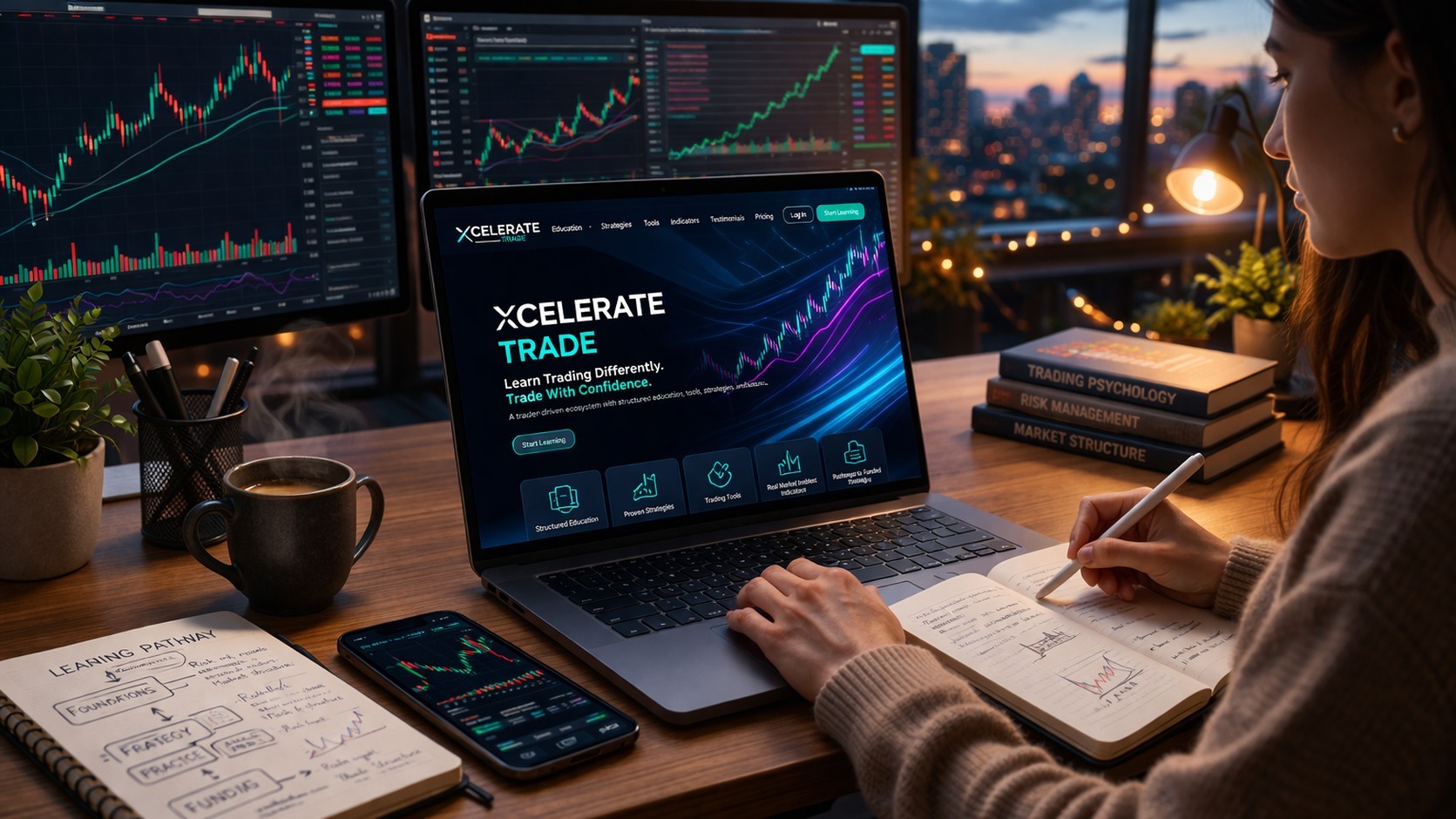
The Academy on Xcelerate.Trade assumes you are starting from zero and walks you through concepts deliberately. Market mechanics come first, so you understand what an order actually does before you place one, and you meet bid, ask and spread before anyone mentions a strategy. The difference between trading and investing gets settled early, which saves a surprising amount of confusion later.
That sounds boring. It is a bit boring. It is also the correct order, and every experienced person I know who tried to learn it backwards ended up paying tuition to the market for the privilege.
Language learning is the closest comparison I can find. You can pick up Spanish from television and conversation, and some people do it brilliantly. Most who get fluent have some structure underneath, and the ones who skip it plateau at a level they cannot diagnose on their own.
Practice before capital, which sounds obvious and almost nobody does
The second thing that counts is somewhere to make mistakes that cost nothing. Demo accounts have a mixed reputation, partly deserved, because trading without emotional stakes teaches mechanics without teaching discipline.
The alternative is still worse. Learning order execution, chart reading and position sizing with live money is a bit like learning to drive by merging straight onto a motorway. Xcelerate Trade keeps practice tools next to the learning material instead of treating them as an afterthought, and the replay function deserves more attention than it gets.
Replay compresses time. Rather than waiting six months to see how a hundred setups resolve, you can work through them across a few focused weekends. Not identical to live experience, obviously, but pattern recognition builds far quicker that way than it does in real time.
Strategies as testable ideas rather than promises
Every strategy is a hypothesis about how a specific market behaves under specific conditions. That is the whole of it. Not a formula, a claim that can be examined and can fail.
Short term index trading makes a decent example. The Nasdaq 100, quoted on most platforms as US100, moves fast around the New York open and around scheduled economic releases. Traders working that instrument on very short timeframes are placing a narrow bet, that liquidity and volatility inside those windows produce small repeatable moves worth capturing.
The material gathered under US100 Scalping Strategies treats that as something to test rather than something to believe, which is the right posture. Scalping is probably the least suitable approach for a beginner, by the way. Transaction costs bite hard at that frequency, execution quality stops being a detail, and the psychological load is heavy. Worth understanding how it works. Rarely worth starting there.
The same logic applies to everything else on the shelf. Trend following suits patience, swing trading suits people with jobs, range and breakout work suit different market conditions entirely, and copy trading suits someone who wants exposure while they learn. Pretending any one of them is universally superior is a marketing decision, not an analytical one.
The parts that deserve scepticism
I promised honesty, so here it is. Any platform with its own token carries an incentive structure worth understanding before you get involved. Xcelerate.Trade has an ecosystem token, and the education side and the token side are related propositions without being the same proposition.
Judge the learning material on whether it makes you better at this. Judge anything financial separately, on its own terms, with the scepticism you would apply to any other asset. Blending those two evaluations is how people end up buying something for the wrong reason.
None of that is a criticism aimed at this company specifically. It is how I would approach any broker, exchange or education provider selling products beyond the education itself.
How I would spend the first ninety days if I were starting now
Concrete beats vague, so let me be concrete.
Month one goes entirely to mechanics and reading, with no positions at all. Order types, what leverage actually does to an account, what a margin call feels like from the inside, and what genuinely moves the instruments you find interesting. Boring, foundational, and the month almost everybody skips.
Month two goes to a demo account with a written plan and a journal. Written, not mental. Every entry rule and exit rule set down in advance, with position size and a clear note on what would tell you the idea had failed, and every trade logged afterwards, including the ones you passed on and why you passed.
Month three goes live with an amount you could lose completely without your life changing. Small enough that the loss is survivable, large enough that the emotions are real, because emotion is the one variable a demo account cannot reproduce.
Then comes the review, and not of the profit and loss. Of the process. Did you follow your own rules, where exactly did you deviate, and what were you feeling at the time? That review is where the learning actually happens and it is the step nearly everyone abandons.
The journal thing is not optional
I sound like a broken record about this and I have made peace with it. A trading journal is the highest return habit in the discipline and it costs nothing but a few minutes a day.
Memory lies. You will recall your winners in vivid detail and quietly rewrite your losers as bad luck. Written records are the only defence against your own storytelling, and after three months of honest entries most people find a pattern they had no idea was there.
Will artificial intelligence just do this for me instead
Fair question, and it comes up in every conversation now. Partly yes, mostly no.
Models handle several parts of the job well. They summarise earnings reports quickly, scan for setups matching criteria you have written down, backtest an idea across years of history in seconds, and catch things a tired human misses at eleven at night. That layer has improved enormously and there is little reason to do it by hand anymore.
What a model does not do is carry the risk. It does not decide how much of your capital belongs behind one idea, it never feels the pull to revenge trade after a loss, and it cannot be held responsible for the account. Delegate the analysis while keeping the psychology and you have automated the easy half.
There is a crowding problem too. When thousands of people run similar models across similar data, whatever edge those models find gets consumed quickly. The advantage drifts back toward whoever is doing something slightly unusual, which in practice tends to mean a human making a judgement call.
How to tell whether this is actually for you
I have a rough test I use when people ask me directly, and it has held up reasonably well over the years.
If the appeal is money, particularly fast money, this will probably go badly. The people who last are the ones who find the problem itself interesting, who enjoy the puzzle enough to keep going through a flat six months where nothing works. Motivation matters here because the feedback loop is slow, noisy and frequently discouraging.
If you cannot comfortably afford to lose the capital, do not start with capital. Learn first, practise second, risk third, in that order, without exceptions. And if you are carrying high interest debt, paying it down is a guaranteed return that beats almost anything you will manage in your first year of trading.
There is no shame in deciding it is not for you. Index investing with regular contributions has produced better outcomes for more people than active trading ever has, and choosing it is a rational decision rather than a failure of nerve.
What I would tell someone standing at the start line in 2026
Learning to trade is still worth it, but the reason has moved. It is no longer a shortcut to income, and anyone presenting it that way is selling you something. It is a way to understand how capital behaves, and occasionally, for people who take the craft seriously, a source of return.
Go in slowly. Use structure rather than scrolling, whether that structure comes from Xcelerate Trade or from anywhere else that teaches in a sensible order. Keep the money at risk small until your process has become boring and repeatable, and keep the journal even during the months when reading it back is embarrassing.
The market will still be there in five years. Your capital might not be if you rush the first six months. That is the whole lesson, and it took me quite a bit longer than one coffee to be able to say it cleanly.
Frequently Asked Questions
How much money do I need to start trading in 2026?
Less than people assume for learning, more than they assume for it to matter. Fractional shares mean you can technically begin with under fifty euro, and for the practice phase that is perfectly adequate. For returns to be meaningful against the time you are putting in, you generally need a few thousand, which is exactly why the learning phase belongs before the funding phase.
Is day trading realistic for someone with a full time job?
In the strict sense, no. Intraday work demands attention during specific market hours and you will be structurally disadvantaged trying to squeeze it between meetings. Swing trading on daily charts, holding positions for days or weeks, fits a working schedule far better and is where most part time traders end up settling.
How long does it take to become consistently profitable?
Nobody can promise a timeline and anyone offering a confident number is guessing. The people I know who got there describe two to three years of sustained effort, with the first year functioning mostly as expensive education. Plenty never get there at all, which is the part that has to be said out loud rather than buried in a disclaimer.
Should I learn technical analysis or fundamental analysis?
It depends entirely on your timeframe. Short term trading leans on price behaviour and order flow, since fundamentals do not change from one hour to the next. Longer holding periods make company financials and macro conditions the dominant factor, and most experienced traders blend the two instead of treating them as rival religions.
What is the difference between trading individual stocks and trading an index like US100?
A single stock carries company specific risk, so an earnings surprise or a management scandal can move it violently regardless of what the wider market is doing. An index spreads that risk across its constituents and therefore responds mainly to macro news and sentiment. Index products are also usually traded with leverage through derivatives, which changes the risk profile substantially and needs to be understood before you go near one.
Is a demo account genuinely useful or just a waste of time?
Useful for mechanics, limited for psychology. You will learn order entry, platform navigation, chart work and the arithmetic of position sizing without paying for the privilege, which is a real benefit. What it cannot show you is how you behave when actual money is moving against you, so treat demo as the driving lesson rather than the licence.
Is scalping a good place for a beginner to start?
Usually not. Very short holding periods make you maximally sensitive to spreads, commissions and execution quality, and those costs quietly eat returns that look fine on paper. Learning how scalping works is worthwhile because it teaches precision, but building your first process around it stacks the odds against you before you have any experience to draw on.
Does artificial intelligence make learning to trade pointless?
No, though it changes what you should be learning. Analysis, screening and backtesting are now cheap and fast, so spending years becoming a mediocre human screener makes little sense. Risk sizing, temperament and the judgement to sit out a bad market remain human problems, and those are precisely the areas where accounts are won and lost.